
Contents
- Introduction
- Moment 1 — Booking and pre-arrival
- Moment 2 — Arrival and check-in
- Moment 3 — The first impression of the room
- Moment 4 — Dining
- Moment 5 — Special requests
- Moment 6 — When something goes wrong
- Moment 7 — Personalised experiences
- Moment 8 — Departure and check-out
- Caring for the team as much as for the guests
- Training the moments, not the slogans
- Bring this training to your property
Introduction
Guests do not remember a stay as a continuous film. They remember moments: a handful of scenes that stand out, good or bad, and from which they build their verdict on the whole property. Ask a returning guest why they came back and they will rarely mention the room rate or the thread count. They will tell you about the person who remembered their name, the problem that was solved before they had finished explaining it, the detail nobody had asked for and everybody noticed.
This is good news for training. If the guest experience is decided at identifiable moments, those moments can be named, broken down into observable behaviours, practised and coached. That is exactly what five-star guest service training should do: stop teaching slogans — “exceed expectations”, “anticipate needs” — and start training the scenes that guests actually remember.
ABP, which publishes this guide, is based in France (Nice) and in Monaco, and works all over the world — in Seychelles as on its clients' other destinations. Our conviction: the excellence in guest service that hotels aim for requires excellence in the training and coaching they offer their teams. That is why we work with them, wherever they are.
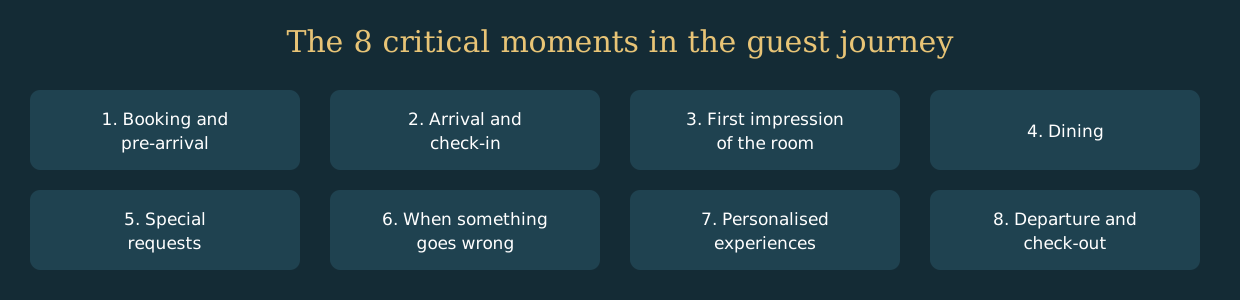
Here are the eight critical moments in the guest journey of a luxury hotel, what is really at stake in each one, and what training changes on the ground.
Moment 1 — Booking and pre-arrival: the stay begins before the guest does
What is at stake. The first judgement is formed before anyone has seen the property. A slow or generic reply to a booking enquiry, a pre-arrival message that ignores what the guest already told you — the purpose of the trip, an allergy, a late arrival — tells the guest they are a reservation number. In Seychelles, where many guests arrive after long-haul flights and inter-island transfers, the pre-arrival exchange is also where anxiety is either removed or created.
The behaviours that make the difference. Reply with the guest’s own information, not around it: “We have noted your arrival on the evening ferry, and your room will be ready whatever the crossing time.” Ask one useful question rather than sending a standard form — the question that uncovers the anniversary, the child’s age, the dietary constraint that the kitchen would rather know today than at the table.
What training changes. Reservations and front-office teams learn to read a booking as a story, not a file: who is coming, why, what could go wrong, what could be prepared. Training builds the habit of a short internal note, passed on properly, so that what the guest said once never has to be said twice.
Moment 2 — Arrival and check-in: the first ninety seconds
What is at stake. The guest arrives tired, sometimes after twenty hours of travel. The first ninety seconds set the emotional tone of the entire stay: a queue at a desk, eyes on a screen, a passport requested before a greeting — and the holiday starts with paperwork. A warm, unhurried welcome does the opposite: it tells the guest they have arrived somewhere they are expected.
The behaviours that make the difference. Stand, greet by name when it is known, and address the journey before the administration: “Welcome — how was the crossing from Praslin?” The formalities follow, handled as a service rather than a checkpoint, ideally seated, with a drink, and with the practical essentials given in the right order: where breakfast is, how to reach the team at any hour, what has already been arranged for them.
What training changes. Teams rehearse the arrival as a choreographed scene, not an administrative procedure — including the difficult versions: the guest who arrives early and whose room is not ready, the family whose transfer was delayed. Trained staff have a prepared, honest way to handle those minutes, so the first memory is of being looked after, not of waiting.
Moment 3 — The first impression of the room: sixty seconds alone with your standards
What is at stake. This is the one moment no team member witnesses — and the one where the guest inspects everything. The guest walks in alone and reads the room like a report: temperature, scent, light, the welcome note, the small defects that housekeeping stopped seeing months ago. In a small island property, where the same people will be seen again at dinner, a disappointing room also creates an awkwardness the guest carries with them.
The behaviours that make the difference. The room must tell the guest they were expected, personally: the name written correctly, the preference mentioned at booking already in place, the temperature set for someone arriving from a tropical crossing rather than left at the previous guest’s setting. And when the guest is escorted, the escort points out two or three things that matter — how the terrace door works, where the light switches hide — instead of reciting the full inventory.
What training changes. Housekeeping and front office train together on the “fresh eyes” discipline: a final sixty-second inspection from the guest’s position, standing where the guest stands, sitting where the guest sits. Training turns the checklist from a form to sign into a scene to verify — because the guest will verify it for real.
Moment 4 — Dining: where service becomes theatre
What is at stake. A guest may forgive a slow check-in; they rarely forgive being invisible in a restaurant. Dining concentrates everything at once: timing, product knowledge, reading a table, coordination between kitchen and floor. It is also where the differences inside a multicultural team show most — what “attentive” means to one culture can feel intrusive to another, and the guest experiences the average of the two.
The behaviours that make the difference. Read the table before serving it: the couple who want a quiet corner and no conversation beyond the essential, the family who want to be entertained and advised. Describe a dish as something to look forward to, not as a list of ingredients. And master the two sentences that save a service: the honest one about a delay — “Your main course will need ten more minutes; may I bring you… in the meantime?” — offered before the guest has to ask.
What training changes. Restaurant teams train the reading of guests as a skill in itself: signals of impatience, of celebration, of a guest who wants to be left alone. Product knowledge is trained as storytelling, and the briefing before service becomes the moment where the floor and the kitchen align on the evening’s guests — who they are, what they celebrated yesterday, what must not be missed tonight.
Moment 5 — Special requests: the moment the standard script runs out
What is at stake. Every luxury guest eventually asks for something that is not in the manual: a proposal set up on a deserted beach, a dish from home for a homesick child, a doctor at midnight, a birthday that must look spontaneous. This is the moment where five-star service is actually decided, because it cannot be scripted — only prepared for. The instinct to say “that is not possible” is the most expensive sentence in a luxury hotel.
The behaviours that make the difference. Never answer the request itself first; answer the person: “Let me see what we can do — give me twenty minutes and I will come back to you with options.” Then come back, at the promised time, even if the answer is a partial solution. A guest accepts almost any constraint explained early and honestly; what they do not forgive is silence, or discovering at the last minute that nothing was attempted.
What training changes. Training replaces reflexes with method: listen fully, confirm what matters most to the guest, commit to a deadline for the answer — not to the result — and keep the guest informed. Teams also build, over time, a shared repertoire of solutions: what the property, the island and local partners can actually deliver, so that creativity starts from knowledge rather than improvisation.
Moment 6 — When something goes wrong: the complaint is a gift with sharp edges
What is at stake. A cold shower, a noisy room, a booking error, a misunderstood bill: incidents happen everywhere, including in the best-run properties. What separates five-star service is not the absence of problems but the quality of the recovery. Handled well, a complaint can leave the guest more loyal than if nothing had happened — they have seen how the property behaves when it matters. Handled defensively, the same incident becomes the story they tell for years.
The behaviours that make the difference. Listen without interrupting and without justifying; acknowledge the experience before explaining the cause: “You are right, that is not the evening you should have had.” Apologise once, sincerely, in the name of the property. Then act visibly and fast, state what will be done and by when, and check back afterwards that the guest felt the difference. Never make the guest repeat their story to three different people: whoever receives the complaint owns it until it is closed.
What training changes. This is the moment training earns its keep. Under pressure, nobody rises to the level of their good intentions; they fall back on what they have practised. Teams rehearse real complaint scenes — the angry guest, the silent guest who is quietly deciding never to return, the complaint that is really about something else — until listening, acknowledging and acting become reflexes rather than efforts. Managers are trained to support, not to take over: arriving to overrule a colleague in front of the guest destroys both the recovery and the colleague.
Moment 7 — Personalised experiences: the detail that could only happen here
What is at stake. Luxury guests have seen beautiful rooms on several continents. What they cannot buy elsewhere is the feeling that this stay, in this place, was composed for them: the snorkelling trip timed to the tide and suggested because someone remembered a breakfast conversation, the Creole dish that appears because the chef heard it mentioned, the child’s name known by the beach team. Personalisation is the moment where a property stops being interchangeable.
The behaviours that make the difference. It rests on an unglamorous discipline: noticing, remembering, and passing information on. The observation made at breakfast must reach the person who can use it at 4pm. The teams that personalise well are not more inspired than others; they are better connected — briefings, handovers and short written notes are the real machinery behind the “spontaneous” detail.
What training changes. Training works on attention itself: what to notice about a guest, how to record it usefully, how to use it without ever feeling intrusive — personalisation should feel like care, never like surveillance. It also trains restraint: one well-chosen detail per day outweighs a programme of forced surprises.
Moment 8 — Departure and check-out: the last scene writes the review
What is at stake. The final moment disproportionately colours the memory of the whole stay — and often the online review written a week later. A billing surprise, a queue at the desk while the transfer waits, a farewell reduced to a card payment: these last ten minutes can tax everything the previous days had earned. Conversely, a departure handled with the same care as the arrival sends the guest away as an ambassador.
The behaviours that make the difference. Prepare the departure the day before: the bill ready to be checked calmly, the transfer time confirmed, the small question that opens the real conversation — “What will you remember most from this stay?” Listen to the answer; it is the most honest feedback the property will ever receive, and anything left unresolved can still be addressed before the guest leaves. The last words should never be about money.
What training changes. Teams learn to treat check-out as a service scene in its own right, not an accounting operation: anticipating disputes by presenting the bill early and transparently, coordinating luggage and transfers so the guest never waits standing up, and closing the loop internally — every remark made at departure is logged and reaches the team it concerns.
Caring for the team as much as for the guests
The idea that changes everything: employees deserve the same care as guests.
None of the eight moments above holds if the women and men who carry them are exhausted, demotivated or left to cope alone. The smile at arrival, the patience in a complaint, the eye that notices the personal detail: none of it can be decreed by a memo. It is passed on — or not — by frontline managers, at the morning briefing, in the corridor between two services, in the way a head of department thanks, corrects or backs up their team. A property cannot durably offer its guests a level of care it does not first give its own people.
Train the managers, not only the teams. Training teams in service without training their managers is sowing seed with nobody to tend it. Supervisors and heads of department are the ones who turn a standard into a habit: briefing in five useful minutes, observing a behaviour rather than a mood, giving feedback that helps people grow, correcting without breaking, recognising without waiting for the end of the season. That is precisely the purpose of our Manager Leader Tools programme: the concrete skills of frontline management, practised on the property’s real situations — held to the same standard of observable behaviour as the eight moments of the guest journey.
Motivating without reaching for the wallet. In island hospitality, where teams often live far from their families and work season after season, the levers that retain and engage people are rarely financial: sincere recognition, fair rosters, room to progress, meaning in the work, the quality of the relationship with the direct manager. Our Motivate and engage training works through the twelve non-financial motivation levers, one by one, so that every manager leaves with actions they can apply the next day — not with intentions.
Recruiting different people — and learning how
Tomorrow’s service will not be uniform. Luxury guests have seen it all, everywhere. What they increasingly expect is originality, specificity, adaptability: an encounter unlike the previous hotel’s, a team able to step off script when the situation calls for it. A team recruited to a single template — same backgrounds, same reflexes, same tastes — produces service that is impeccable and interchangeable. Different profiles, well composed, create the singularity guests talk about when they get home.
Learning to recruit difference. The catch is knowing how to recognise it — and not recruiting, by reflex, one’s own reflection. It can be learned: reading an atypical career path as a resource, spotting what a given temperament will bring to the existing team, building complementarities rather than stacking duplicates. Our Enneagram training gives managers this reading of personality profiles: understanding what deeply motivates each person, recruiting the person the team is missing — not the one who resembles it — and then making very different profiles work together. Here, self-knowledge is not a personal-development luxury: it is a recruiting and cohesion tool.
Training the moments, not the slogans
None of these eight moments requires exceptional people. They require ordinary professionals who know exactly what is expected at each scene, have practised it, and are coached on it by managers who were trained to observe and give feedback. That is the difference between a standard displayed in the back office and a standard a guest can feel.
This is how ABP Hospitality works, in Seychelles as wherever its clients call on it: based in France (Nice) and in Monaco, the team works worldwide, with programmes built with the property, around its operation and its seasons, delivered in French, English or Spanish, and translated into observable behaviours for each department — front office, housekeeping, restaurant, and the supervisors who hold it all together between briefings. In a small island property, where every team member is visible to every guest, consistency across the eight moments is not a refinement. It is the product.
Photo credits (royalty-free — Pexels)
- Header image — Infinity pool facing the ocean, Maldives. Photo: Asad Photo Maldives. Source page: https://www.pexels.com/photo/swimming-pool-by-the-sea-11118953/ · File used: https://images.pexels.com/photos/11118953/pexels-photo-11118953.jpeg?auto=compress&cs=tinysrgb&w=1600
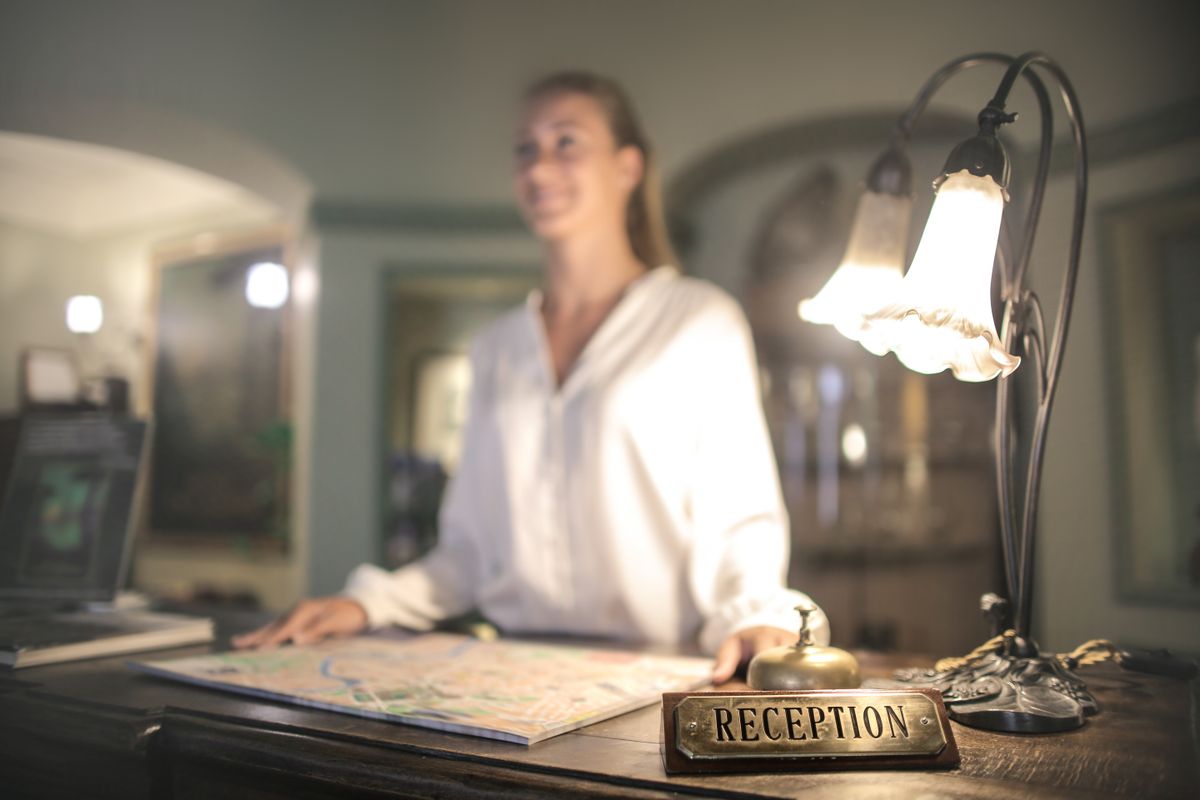
- Moment 2 (arrival) — Receptionist behind the front desk. Photo: Andrea Piacquadio. Source page: https://www.pexels.com/photo/hospitable-woman-standing-behind-front-desk-3771087/ · File used: https://images.pexels.com/photos/3771087/pexels-photo-3771087.jpeg?auto=compress&cs=tinysrgb&w=1200
- Moment 4 (dining) — Waiter carrying gourmet plates. Photo: Matheus Bertelli. Source page: https://www.pexels.com/photo/waiter-carrying-plates-with-salad-25809277/ · File used: https://images.pexels.com/photos/25809277/pexels-photo-25809277.jpeg?auto=compress&cs=tinysrgb&w=1200
- Management section — Concierge behind a wooden front desk. Photo: Andrea Piacquadio. Source page: https://www.pexels.com/photo/wooden-front-desk-for-reception-3771811/ · File used: https://images.pexels.com/photos/3771811/pexels-photo-3771811.jpeg?auto=compress&cs=tinysrgb&w=1200
- 8-moments diagram — created by ABP Hospitality: file `schema_8_moments.svg` (same folder).
Alain Palacios and the specialists who co-design the programmes with him train and coach hospitality managers and teams, with a focus on luxury service standards, frontline management and team cohesion. Based in France (Nice) and in Monaco, they work all over the world.